
Summary
USPS postage rates are going up again on July 12, 2026. For utilities, the bigger issue is not just the four-cent stamp increase. It is the full cost of mailing bills, notices, reminders, and postcards every month. Paperless billing can help, but the best strategy is to reduce paper where customers prefer digital, keep paper where customers need it, and use UPM to make the remaining print-and-mail process less manual, less expensive, and less stressful.
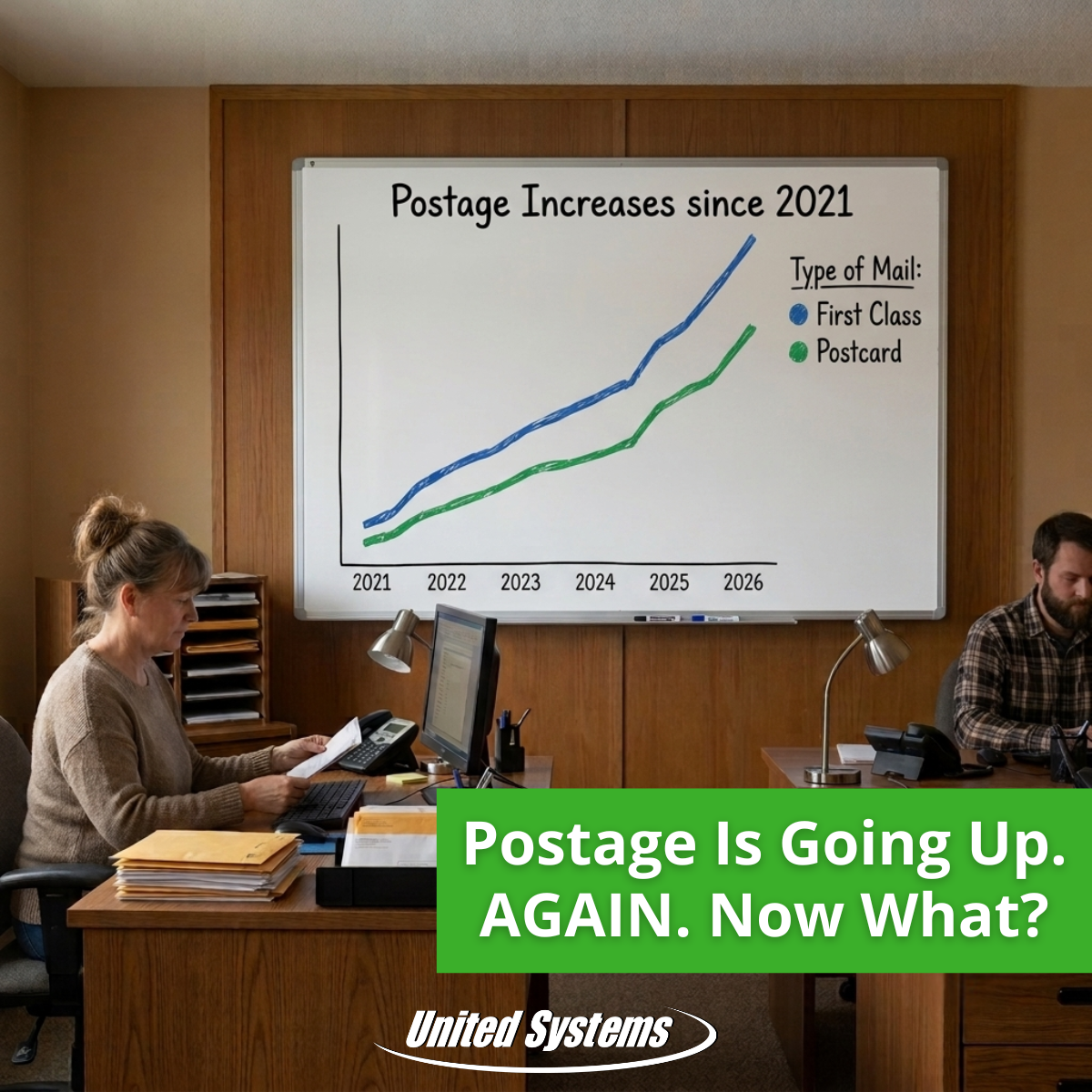
Postage Is Going Up. Again. Now What?
USPS postage rates are increasing again this weekend.
That means every mailed utility bill, notice, reminder, and postcard is getting a little more expensive to send.
What’s changing?
Starting July 12, 2026:
- A First-Class stamp increases from $0.78 to $0.82
- A domestic postcard increases from $0.61 to $0.65
Both are four-cent increases.
Alone, that doesn’t warrant its own melancholy entrance music.
But multiply four pennies by every mailed bill, every notice, every month, and the dollars really start to add up.
Why this matters for utilities
Postage is only part of what utilities pay for mailed billing.
That cost includes paper, envelopes, inserts, printing equipment, staff time, returned mail, and the monthly pressure of getting bills out correctly and on time.
Postage is the price increase you see. What you may not see is the additional costs imbedded in the processes around it.
That matters because most utility teams are already stretched. You’re probably managing billing, payments, customer calls, field work, and reporting with fewer people than you would like.
So, when postage goes up, yes, you’ll undoubtedly ask:
“How much more will stamps cost?”
But you should also ask:
“Why are we still carrying so much of this process ourselves?”
Should utilities push customers to paperless billing?
Yes, with a caveat.
Undoubtedly, paperless billing can reduce mail volume. Incentives can help, too. Credits, drawings, giveaways, and clear customer education can all move more people toward paperless billing.
But forcing every customer into paperless billing is not the answer.
Auto-enrolling everyone with an email address may make paperless numbers look better, but it doesn’t always reflect actual customer preference. Some customers won’t notice. Some won’t care. Some will still need paper.
The trick is to move as many customers as possible toward digital options when they genuinely prefer them, while making the remaining print-and-mail process more efficient.
Also, not all paperless billing solutions are the same. Some will barely move the needle.
Whereas others, like United Systems’ Utility Process Management (UPM), could result in a 75% decrease in mail-in payments alone—each of which must be manually processed!
Where UPM helps
Our platform integrates key utility operations into a single platform, including billing/CIS, payments, metering, work orders, customer communication, and print and mail.
UPM’s print and mail functionality handles bill printing, delinquent notices, mail processing, and postage for you. Because it works with the billing/CIS process, print and mail doesn’t sit off to the side as another separate operation your staff has to manage manually.
That helps utilities reduce the overhead tied to in-house printing and mailing, including supplies, equipment, maintenance, and staff time.
It also gives customers more billing and payment options over time, including paperless billing and autopay.
That combination matters, because the realistic strategy should be:
- Reduce paper where customers want digital.
- Keep paper available where customers need it.
- Stop making your staff carry the full weight of the mailing process.
Not “make everyone paperless tomorrow”… as amazing as that would be!
Bottom line
The July 12 postage increase is fixed. Your cost per mailed bill is not.
Utilities can’t control USPS rates, but you can control how much labor, time, and manual work goes into each billing cycle.
Postage may (will?) keep increasing, but your stress level and bottom line don’t have to go up alongside it.
Ready to reduce friction across operations?
Coordinate billing, payments, customer service, metering, work orders, and operational workflows through utility-focused technology and support services. Talk with our team to learn how United Systems supports utilities through technology, operational services, metering, customer service, and workflow management.