
Summary
This article outlines six practical ways utilities can keep billing operations moving when mail service is disrupted by severe weather, facility closures, or other unexpected events. It covers assessing the disruption, prioritizing time-sensitive communications, using alternate bill production and delivery methods, keeping customers informed, offering other payment options, and creating a billing continuity plan before a crisis occurs.
How utilities can keep billing moving during mail service disruptions
Utility bills still have to go out, even when normal mail service doesn’t.
Flooding, tornadoes, winter weather, facility closures, and other disruptions can delay or temporarily interrupt local mail service. When that happens, you need to quickly determine what’s affected, identify time-sensitive communications, establish another way to send them, and keep customers informed.
Just as important, utilities should have a plan before a disruption occurs. I’ve outlined six ways to keep a disruption from becoming a crisis.
1. Confirm the scope of the disruption
Regardless of the cause, when mail service is disrupted, start by determining exactly what’s affected. The disruption could involve one local post office, several ZIP codes, a regional processing facility, or a larger area impacted by severe weather.
Check whether:
- Incoming or outgoing mail is affected
- Mail is being rerouted
- Certain ZIP codes are delayed
- Local facilities are temporarily closed
- The disruption is expected to last hours, days, or longer
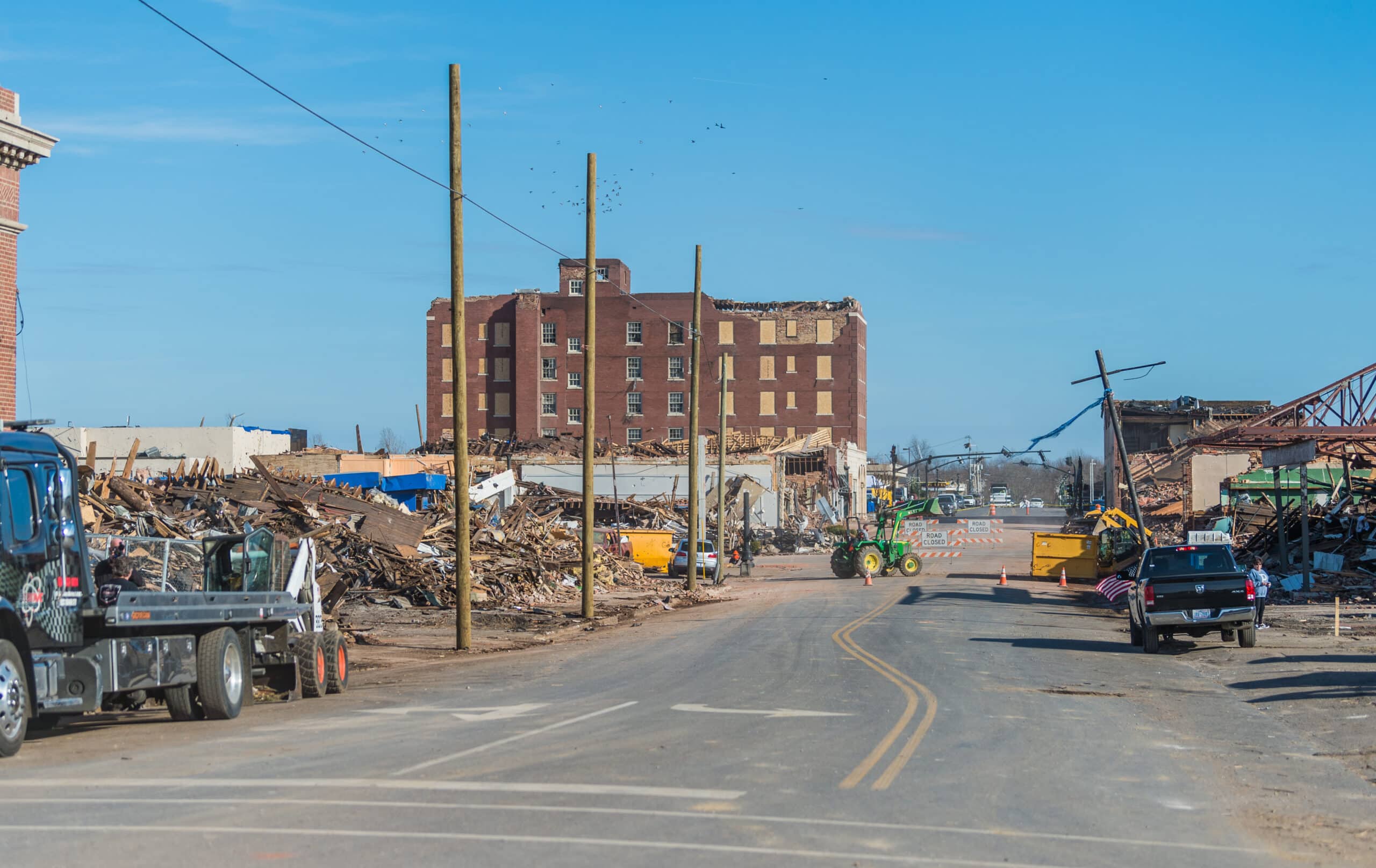
CAPTION (Above): Aftermath of December 2021 tornado in
Mayfield, KY. Photo taken by State Farm. CC by 2.0.
https://commons.wikimedia.org/w/index.php?curid=113426916
The U.S. Postal Service (USPS) maintains service alerts for facility disruptions, weather events, and other circumstances that can affect processing and delivery. Knowing the scope helps you decide whether the situation calls for a minor adjustment or an alternate mailing process altogether.
2. Identify which communications can’t wait
Bills are only part of the picture. You may also need to send delinquency notices, disconnect notices, regulatory communications, and other time-sensitive documents.
Determine which communications are affected and prioritize them based on urgency.
Utilities should also review applicable state and local requirements before changing deadlines, fees, notices, or disconnect procedures. A postal delay doesn’t necessarily change those obligations.
When a local disaster takes mail service offline
We’ve seen disasters severely impact the mail for several customers. Just over the last few years, major flooding and tornadoes throughout Kentucky have affected communities badly enough that normal local mail service was unavailable for days or even weeks.
Take Mayfield, KY, for example: full operations did not resume until 4 months after the catastrophic December 10, 2021, tornado that destroyed the town’s post office (among so many other structures).
Your utility may still be able to generate bills after such a disaster, but that doesn’t help much if the usual path for getting those bills into customers’ hands has disappeared.
3. Establish another way to produce and send bills
If your normal process is USPS-heavy and that process becomes unavailable, can bills and notices be produced somewhere else?
For utilities that handle printing and mailing internally, the disruption may involve more than the post office. Equipment may be inaccessible. Employees may not be able to reach the office. The utility itself may be just as impacted by the disruption.
So, consider a continuity plan, which might include:
- An alternate mailing facility
- An outside print-and-mail provider
- Electronic delivery for participating customers
- A secure process for transferring billing files
- Another office capable of producing bills
The goal is to avoid having only one way to produce and distribute bills and other critical correspondence.
4. Tell customers what’s happening
When customers don’t receive a bill when they expect one, they almost never call the post office. That’s right: they call the utility.
So, mail disruption can quickly become a customer-service problem. If bills or notices are likely to arrive late, communicate through the channels already available to you—such as your website, email, text messaging, customer portal, social media, or automated phone messages.
Keep the message simple and confined to the basic what/when/how:
What do you owe? When is it due? How can you pay it?
Answer those questions clearly to make serious headway through the crisis.
When an entire region slows down
Many of the utilities we serve are in the lower Midwest and South, where a significant snow or ice event can bring normal operations across an entire region screeching to a halt.
Roads become difficult or unsafe. Businesses close. Employees may be stuck at home.
Mail processing and delivery can slow down along with everything else. In those situations, several parts of the billing, mailing, payment, and customer-service process may be affected at the same time.
That makes the larger question even more important:
How do you keep essential billing operations moving when normal operations across entire communities are disrupted?
5. Give customers other ways to receive information and pay
Like it or not, paper bills remain important for many customers, but they shouldn’t be the only way a customer can find out what they owe or make a payment.
Thankfully, there are several ways to reduce the risk of relying too heavily on paper bills:
- Electronic billing
- Online customer portals
- Online payments
- Automated phone payments
- Bank draft or recurring payments
- Email or text notifications
These multiple options create resilience for your utility. If one communication channel is temporarily unavailable, the entire billing process won’t have to stop alongside it.
6. Build the plan before you need it
The middle of a tornado, flood, or ice event is not the best time to design a billing continuity plan. In fact, it might be the worst because you’re being reactive—instead of proactive—and the decisions will very likely be rushed.
At a minimum, your continuity plan should answer five questions:
- Who decides when an alternate process is activated?
- Where can bills be produced if the normal location is unavailable?
- How will billing files be transferred securely?
- How will customers be notified?
- When was the process last tested?

Obviously, you can’t predict every possible disruption. But you can make sure an unexpected event doesn’t require everyone to rush through a plan or invent one from scratch.
Print and mail as part of billing continuity
For utilities that want another option for producing and distributing customer bills, United Systems provides print and mail services as part of Utility Process Management (UPM).
Print and mail can reduce dependence on internal equipment, staff availability, and a single local mailing process while giving utilities another way to keep bills moving when circumstances change… even if those changes aren’t brought on by impacts to the local post office.
Some call this “outsourcing printing,” but I like to think it’s another operational option when the traditional mailing process is unavailable or, for many of our customers today, no longer satisfactory.
No matter what, the best time to answer, “What happens if we can’t mail bills tomorrow?” is today. With the right plan in place, a mail disruption doesn’t have to become a billing disruption.
Frequently Asked Questions
What happens to utility bills if a local post office closes?
Mail may be rerouted through another facility, but delays are certainly possible. Utilities should determine which customers are affected and whether an alternate mailing process is necessary.
Can utility bills be mailed from another location?
Yes. Bills may be produced and mailed from another facility or through a print-and-mail provider, depending on the utility’s processes.
How should utilities notify customers about mail delays?
Use available channels such as your website, email, text messaging, customer portal, phone messaging, social media, and customer service staff.
How can utilities prepare for postal service disruptions?
Create a billing continuity plan that covers alternate mailing options, secure file transfer, staff responsibilities, customer communication, and alternative payment channels.
Ready to reduce friction across operations?
Coordinate billing, payments, customer service, metering, work orders, and operational workflows through utility-focused technology and support services. Talk with our team to learn how United Systems supports utilities through technology, operational services, metering, customer service, and workflow management.