
Summary
This blog explains seven common signs that a small or mid-sized utility has outgrown its current billing software, including manual data entry, billing errors, rising customer complaints, spreadsheet dependence, slow reporting, disconnected field and office data, and limited integration options. It also outlines what modern utility billing software should do and positions United Systems & Software’s UPM platform as a practical solution.
7 Signs Your Utility Needs Better Billing Software
Missed payments. Billing errors that take too long to trace. Staff re-keying the same data into multiple systems.
For small and mid-sized utilities, those problems are more than daily annoyances. They’re usually signs the billing process has outgrown the tools supporting it.
And no, this doesn’t mean your team’s doing anything wrong. Most utility staff are already performing small miracles with limited time, limited people, and systems that were “temporary” sometime around the turn of the millennium.
A billing system should help your team move from meter reads to accurate bills to timely payments without creating extra work at every handoff. When it can’t do that, staff time is lost to workarounds, customers lose confidence, and leadership has a tougher time getting the information they need.
Here are seven signs your utility may be ready for a better billing approach.
1. Manual data entry eats into staff time
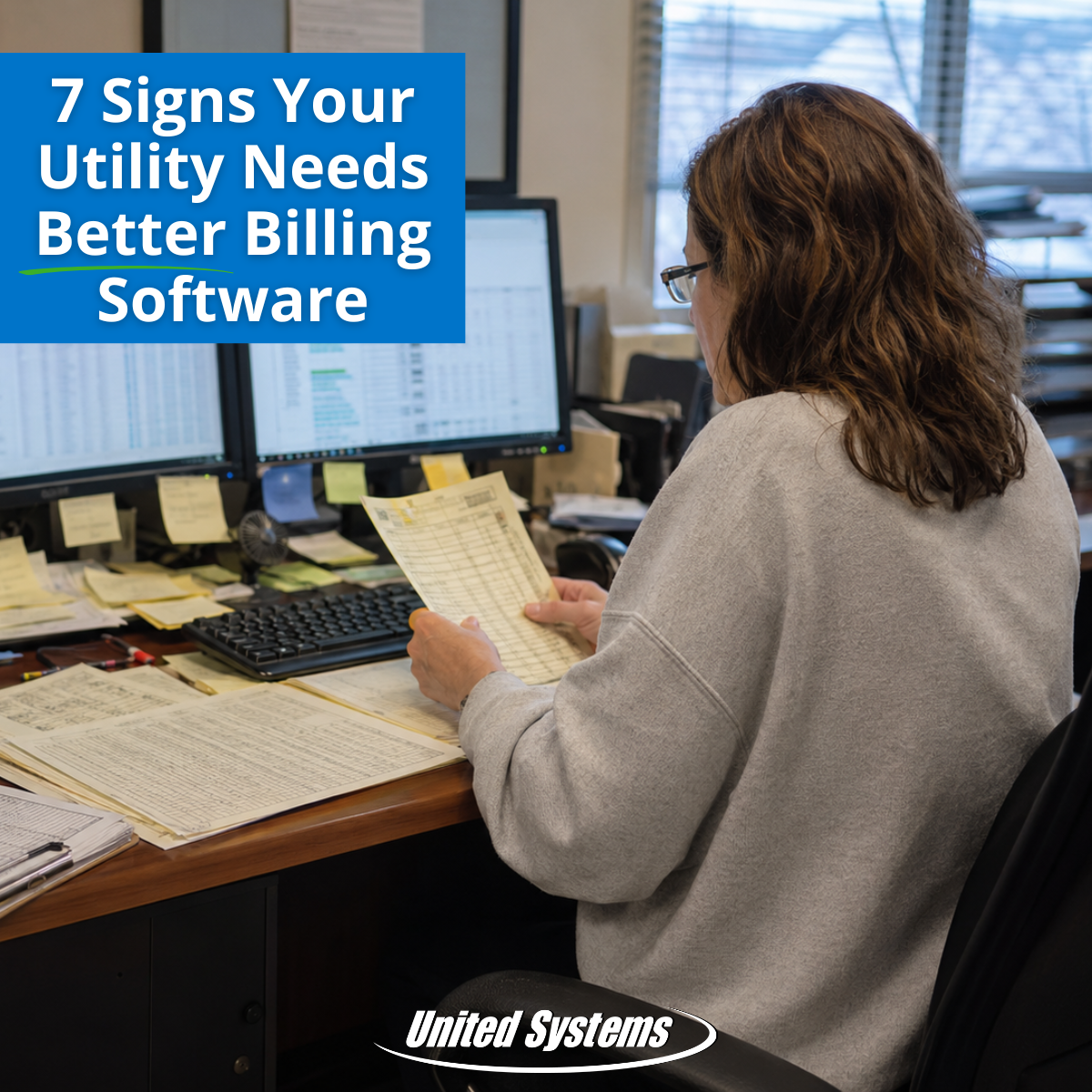
If your billing clerk starts the day exporting meter reads, copying customer data, and moving payment information between systems, your team is paying a “spreadsheet tax.”
The work may feel normal because it happens every cycle. That doesn’t make it efficient.
Manual handoffs create more chances for errors. They also make it harder to know which system has the most current information. When three systems each think they are the source of truth, congratulations… you now have three sources of confusion.
Watch for:
- staff creating spreadsheets to bridge gaps between systems
- the same customer information living in several places
- billing preparation taking days before actual bill calculation begins
2. Billing errors spike after rate changes
Rate changes shouldn’t turn into a scavenger hunt. When staff must update multiple rate tables, fee schedules, customer classes, and spreadsheets, small mistakes can spread quickly.
Your utility billing system should handle tiered rates, seasonal adjustments, multi-service accounts, and customer classifications without forcing your team to rebuild the process each time rates change. A rate change should be a planned update, not a group project draining your human capital.
Watch for:
- rate updates needing to be entered in multiple places
- staff needing outside spreadsheets to verify calculations
- customer service calls increasing after every adjustment
3. Customer complaints keep climbing
Customers don’t care what system produced the bill. They don’t care who’s to blame.
They do care whether the bill is accurate, understandable, and easy to pay. When internal systems fail, customers see unexplained charges, delayed payment confirmations, and bills that don’t match their expectations.
Even if it’s the software’s fault, it’s your utility’s problem.
A better billing process reduces avoidable calls by giving customers clearer bills, better payment options, and self-service access to account information.
Nobody wants customers to call the utility just to answer a question a portal could have handled in 12 seconds. Including your staff. Especially your staff.
Watch for:
- call volume rising every billing cycle
- disputes taking days to resolve because staff must research multiple systems
- customers asking questions a portal could answer immediately
4. Spreadsheets can’t keep up with growth
Spreadsheets may work for a small number of accounts. But as your utility grows, they become harder to govern, harder to secure, and easier to break. Plus, one bad formula or outdated file can create problems across hundreds or thousands of bills.

Spreadsheets aren’t useless. They’re just not meant to be the operating backbone for utility billing.
That’s like asking a garden hose to run a water treatment plant. “E” for effort, but definitely the wrong tool.
Watch for:
- files slow to open, save, or share
- important formulas understood by only one person
- the wrong version of a file causing billing problems
5. Reporting takes days instead of minutes
City councils, auditors, managers, and regulators all need reliable information. If every report requires staff to export data from several systems and stitch it together manually, reporting becomes a burden instead of a management tool.
Modern utility billing software should make common reports easier to produce because billing, payments, customer records, and operational data are connected. The goal’s simple: less hunting, less copying, less “who has the latest version?” and more usable information when it’s actually needed.
Watch for:
- standard reports requiring manual exports and cleanup
- historical billing information difficult to access
- audit preparation consuming weeks of staff time
6. Field and office data do not match
The field team marks a service order “complete.” The office still shows it as “open.” A customer calls, and nobody can quickly explain what happened.
That’s what disconnected systems do: they turn what should be a basic update into reconciliation work.
When mobile work orders, meter reads, and customer accounts connect to billing, status updates move with the work. Staff spend less time chasing discrepancies and more time solving actual problems.
Fewer mysteries. Fewer sticky notes. Fewer of those dreaded “let me check with someone and call you back” moments.
Watch for:
- field crews using paper forms to be entered later in your billing system
- meter reads requiring manual imports before billing can begin
- discrepancies surfacing only after customers call
7. Your billing system blocks the improvements you want to make
This may be the clearest sign. If your team wants AMI integration, customer portals, mobile service orders, automated payments, or better reporting — but the current billing system cannot support them — then the system is no longer just outdated. It’s limiting your operations.
Better billing software should not be one more tool for staff to manage. It should be the foundation that connects meter-to-cash work across the utility. Otherwise, every improvement becomes another workaround devastating your team’s efficiency.
Watch for:
- new processes requiring more workarounds instead of fewer
- limited, expensive, or unavailable integrations
- staff avoiding improvements because the system makes them too difficult
What better utility billing software should do
Not every utility needs the same feature set. But any billing platform built for utilities should reduce manual work, support utility-specific rate structures, and connect the major parts of the billing cycle.
At a minimum, the system should:
- handle complex rates, seasonal adjustments, and multi-service accounts
- connect billing, customer information, meter data, payments, and field work
- maintain reliable audit trails and access controls
- make customer self-service easier through online payment and account tools
- produce useful reports without requiring days of manual assembly
Generic invoicing tools can send bills. Utility billing software needs to do more than that. It has to support the way utilities actually operate… including the messy, specific, very real parts that never show up in a generic demo.
How United Systems can help
If these warning signs feel familiar, it may be time to look at whether your billing system still supports your utility or quietly makes every cycle harder than it needs to be.
United Systems & Software’s UPM platform connects billing/CIS, metering, mobile work orders, customer portals, payments, and reporting in one utility-focused ecosystem.
Let’s start with a discussion… a practical conversation about what’s working, what isn’t, and what would make your next billing cycle a little less painful.
Ready to reduce friction across operations?
Coordinate billing, payments, customer service, metering, work orders, and operational workflows through utility-focused technology and support services. Talk with our team to learn how United Systems supports utilities through technology, operational services, metering, customer service, and workflow management.